Starfield Free Lanes Turns Loading Screens into Playable Space
- Free Lanes introduces Cruise Mode, turning intra-system travel from fast travel into continuous, explorable space with dynamic encounters.
- X‑Tech becomes a cross-cutting resource for rerolling and upgrading legendary gear and ships, deepening late-game optimization.
- Starborn progression is decoupled from repeated New Game Plus runs via Quantum Essence and a new Quantum Entanglement Device.
- Anchorpoint Station, expanded outpost tools, and new POIs, vehicles, and housing broaden non-linear and sandbox play.
- Launched alongside the Terran Armada DLC and a wider platform rollout, the patch signals a long-term systems roadmap for Starfield.
The Free Lanes update, released as part of Starfield’s v1.16.236 patch, is framed across Bethesda’s communications and specialist coverage as the game’s most transformative systems overhaul to date. Delivered as a free update on PC and Xbox Series X|S, and aligned with the Terran Armada DLC and a wider platform launch, it restructures core loops around movement, loot, and progression rather than simply layering in more content.
Cruise Mode: Space as a Continuous Playspace, Not a Menu
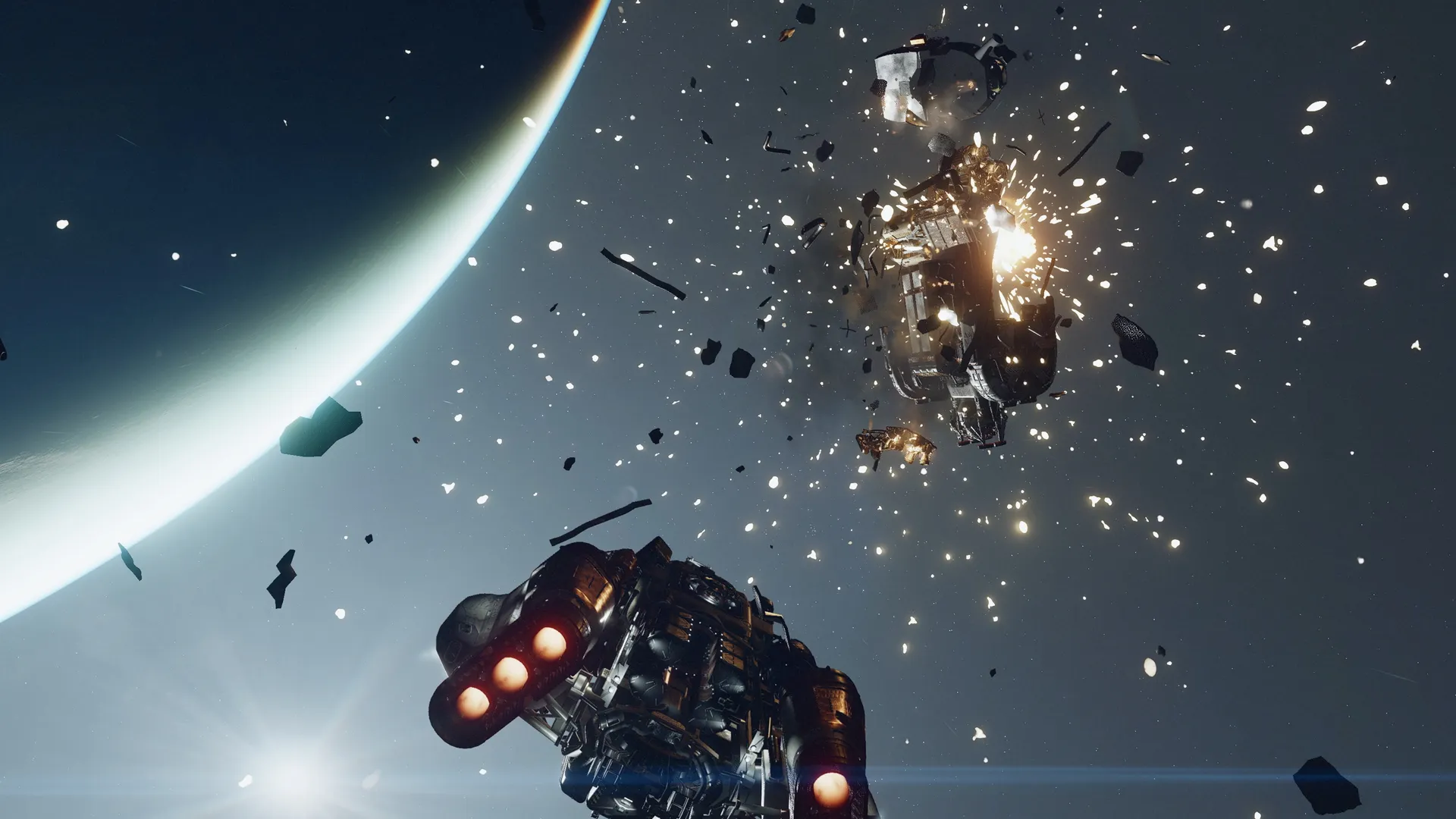
Prior to Free Lanes, Starfield’s spaceflight was structurally closer to a node-based fast travel system: limited manual flying, frequent loading screens, and a focus on destinations rather than transit. Cruise Mode fundamentally changes that within star systems. Once engaged, ships travel seamlessly between planets and in-system locations, with space populated by new points of interest, encounters, and combat opportunities.
Crucially, Cruise Mode does not lock players into the cockpit. While the ship is underway, crew spaces and workbenches remain accessible, allowing crafting, dialogue, and light management activities during transit. This shifts “dead time” between locations into active playtime, which has implications for session length and perceived friction. Transit becomes a discovery surface where new ship battles, derelicts, or DLC hook points can appear, rather than a non-interactive gap.
Industry reporting on the Terran Armada DLC highlights that its dynamic Incursions and new space locations are designed to surface within this denser in-system layer. That linking of free systemic update (Free Lanes) and paid narrative layer (Terran Armada) underlines a broader live-ops strategy: use systems patches to reconfigure the canvas, then drop premium content that exploits the new structure.
X‑Tech: Centralizing Gear and Ship Optimization
X‑Tech is the second pillar of Free Lanes, introduced as a shared optimization resource for weapons, armor, and ships. Dropping from bosses, high-value chests, ship wreckage, and Starborn encounters, X‑Tech can reroll legendary effects on equipment and unlock higher-tier modifiers.
The reroll mechanic follows a two-phase structure. Initial uses randomize legendary traits; after multiple rerolls on a given item, the full modifier list unlocks for direct selection. In systemic terms, this moves Starfield away from pure RNG loot chasing toward a hybrid model where randomness gates speed, but not ultimate build completion. For engaged players, it substantially reduces the frustration of never rolling a specific defensive or elemental modifier, while still preserving grind for X‑Tech itself.
X‑Tech also underpins a new ship optimization terminal that can be added to player vessels. From there, shield strength, engines, and grav drives can be tuned using the same currency. This consolidates what had been a scattered ship progression path-spread across vendors, parts drops, and credits-into a more legible upgrade funnel. The likely effect is a clearer late-game chase: farm X‑Tech through higher-end encounters, then reinvest into both combat builds and flagship ships.
On the difficulty side, coverage notes that enemies, including Terran Armada units, can spawn with new X‑Tech-powered modifiers such as reinforced shields or elemental effects. That escalation is important: it keeps the challenge curve responsive to the new power ceiling unlocked by Tier 4 legendaries and the added Superior and Exceptional equipment tiers.
Starborn and New Game Plus: Endgame Without Full Resets
Free Lanes adjusts one of Starfield’s most debated structures: the reliance on repeated New Game Plus cycles for Starborn progression. Quantum Essence now serves as a dedicated resource for ranking up unlocked Starborn abilities, with drops tied to high-end activities rather than mandatory fresh universes.
This decouples endgame growth from full campaign replays, broadening accessibility for players who completed a single run but were unwilling to restart. Powers can be favorited for faster swapping and combo play, framing Starborn abilities more like an evolving action kit than a static reward from linear temple discovery.
Alongside this, the Quantum Entanglement Device, buildable at The Lodge, enables a limited set of items to persist across Unity transitions. That partial continuity softens the psychological cost of entering New Game Plus and aligns Starfield more closely with roguelite-informed progression, where some persistent meta-growth coexists with universe resets.
Anchorpoint Station, Outposts, and Sandbox Longevity
Free Lanes also invests heavily in sandbox infrastructure. Anchorpoint Station, a new starstation located in the remote Algorab system, acts as a late-game hub combining merchants, quests, and narrative hooks into Terran Armada content. Its remoteness, and the ship capability required to reach it, effectively mark it as endgame-tier space, giving high-level players a distinct destination outside traditional faction hubs.
Outposts receive systemic quality-of-life upgrades that alter resource and logistics play. Shared outpost containers now link storage across multiple bases, reducing friction in multi-planet industrial setups. A new Outpost Database, viewable from the character menu, centralizes key data on locations and resources, which had previously lived in scattered UI elements. Cosmetic and lifestyle additions, such as the Milliewhale outpost pet, layer identity and collectability on top of the functional base framework.
Beyond these, the Moon Jumper land vehicle, an asteroid-base home, additional planetary points of interest, and a set of stat-buffing Colony War Action Hero collectibles expand the game’s catalogue of traversal, housing, and exploration content. None of these individually reframe the experience, but together they broaden the canvas for post‑campaign play and align with Bethesda’s historical emphasis on open-ended sandboxing.
Strategic Context: Live Support Amid Corporate Friction
The timing of Free Lanes and Terran Armada, coinciding with a broader platform rollout, positions Starfield as an ongoing live product rather than a one-and-done single-player RPG. This comes against a backdrop of public criticism from former Bethesda executive Pete Hines, who recently described feeling powerless under Microsoft’s ownership and characterized the studio as being “damaged” and “abused” during his final months. That dissonance-between internal cultural tension and visible external investment in systems-heavy updates—will remain a key dynamic to track for Bethesda’s future roadmap.
In competitive terms, the Free Lanes patch pushes Starfield closer to systemic space sims where traversal, ship management, and dynamic encounters form the core loop, while retaining Bethesda’s RPG framing. By turning previously static layers—spaceflight, legendary rolls, New Game Plus—into more malleable systems, the update attempts to address criticisms around repetition and dead time without abandoning the existing content slate.
InsightsFinalBoss Signal: Free Lanes is less a content drop and more a structural rewrite that increases the game’s surface area for live balancing and future DLC integration. The key signals to watch are engagement around Cruise Mode encounters, uptake of X‑Tech-driven optimization as a long-tail grind, and whether the new Starborn and outpost tools meaningfully shift endgame retention curves for Starfield’s expanding multi-platform audience.
Leave a Reply